Hola. Hello.
Hoy les traigo... cómo armar una oración subordinada(Nebensatz) en alemán.
Today I bring you... how to make a subordinate sentence(Nebensatz) in German.
Empieza con la persona(ich, du, er, sie, es, ihr, Sie, sie, wir), y el verbo conjugado en esta persona. Añadir: ..., dass
Al final de la oración poner el verbo conjugado en la persona después del 'dass'.
La oración debería quedar así: (persona) (verbo conjugado EN PRESENTE) , dass (persona) (la oración subordinada) (verbo conjugado en esa persona).
Begins with the person, and the conjugate verb in that person, add: ..., dass (person), and at the end of the sentence the verb conjugated in the person after 'dass'.
The sentence should be: (person) (verb conjugated in that person IN PRESENT) , dass (person) (the subordinate sentence) (verb conjugated in the person after 'dass')
Debería ser: ich denke, dass du zwei Eier hast(yo pienso que tú tienes 2 huevos)
Should be: ich denke, dass du zwei Eier hast(I think, you have got 2 eggs)
Gracias por leer.
Thanks for reading.
sábado, 7 de octubre de 2017

jueves, 5 de octubre de 2017
Primeros Pasos I: ABC-Menü, saludos,
Buenas, y bienvenidos al primer post(en español) del blog.
Sin más preámbulos, aviso que en los posts de Alemán van a ver algún verbo, gramática.
Alemán, creo que ya sabrán, tiene DECENAS y DECENAS de artículos, pero empezaré con unas tablas de éstos, los pronombres, el ABC-Menü(alfabeto) y los saludos.
ABC-Menü
Deutsch = pronunciación
a
b = be
c = ce
d = de
e
f = fe
g = ge
h = ha
i
j = iot(la 'j' suena como 'i')
k = ka
l = el
m = em
n = en
o
p = pe
q = ku
r = er
s = es
t = te
u
w = we('w' suena como 'v')
x = iks
y = üpsilon (abajo hay una lista de letras "extrañas")
z = tset
Umlaute
ä = sonreír y decir 'a'
ö = cara de 'o' y decir 'u'
ü = cara de 'u' y decir 'i'
Nur auf Deutsch(sólo en Alemán)
ß = eszett
Saludos Saludos iniciales
Hallo: hola, informal.
Guten Morgen: buen día, formal.
Guten Tag: buenas tardes, formal.
Guten Abend: buenas noches, formal.
Después podrías decir: ,,Wie geht es?'', se responde con ,,Gut, und du/Sie?"
Gute Nacht: buenas noches, cuando vas a dormir.
When Leaving
Tschüss: adiós. Informal.
Auf Wiedersehen: hasta luego, formal.
Tan fácil como eso
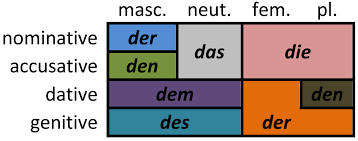
Ahora, les traigo 2 tablas con casos, géneros, y sus artículos
Pista: hay 4 casos y 4 personas.

wir = nosotros
ihr = ellos/as
Sie/sie = Usted/es(respectivamente)
Sin más preámbulos, aviso que en los posts de Alemán van a ver algún verbo, gramática.
Alemán, creo que ya sabrán, tiene DECENAS y DECENAS de artículos, pero empezaré con unas tablas de éstos, los pronombres, el ABC-Menü(alfabeto) y los saludos.
ABC-Menü
Deutsch = pronunciación
a
b = be
c = ce
d = de
e
f = fe
g = ge
h = ha
i
j = iot(la 'j' suena como 'i')
k = ka
l = el
m = em
n = en
o
p = pe
q = ku
r = er
s = es
t = te
u
w = we('w' suena como 'v')
x = iks
y = üpsilon (abajo hay una lista de letras "extrañas")
z = tset
Umlaute
ä = sonreír y decir 'a'
ö = cara de 'o' y decir 'u'
ü = cara de 'u' y decir 'i'
Nur auf Deutsch(sólo en Alemán)
ß = eszett
Saludos Saludos iniciales
Hallo: hola, informal.
Guten Morgen: buen día, formal.
Guten Tag: buenas tardes, formal.
Guten Abend: buenas noches, formal.
Después podrías decir: ,,Wie geht es?'', se responde con ,,Gut, und du/Sie?"
Gute Nacht: buenas noches, cuando vas a dormir.
When Leaving
Tschüss: adiós. Informal.
Auf Wiedersehen: hasta luego, formal.
Tan fácil como eso
Ahora, les traigo 2 tablas con casos, géneros, y sus artículos
Pista: hay 4 casos y 4 personas.

Seguro que se confundieron con este último. No se preocupen, se los voy a explicar.
Pronombres Personales
ich = yo
du = tú
er = el
sie = ella
es = (objeto, en alemán va con artículo neutro: das)wir = nosotros
ihr = ellos/as
Sie/sie = Usted/es(respectivamente)
lunes, 11 de septiembre de 2017
First Steps I: ABC-Menü, Greetings, Articles(EN)
Hello and welcome to the first post of this blog!
Well, let's go to the stuff. On each post regarding learning German, you'll see some grammar and verb stuff.
German, you might know, has HUNDREDS of articles, but, I'll begin with some article sheets, the pronouns, the ABC-Menü and the greetings.
In German, "e" sounds like it does in "Germany", "a" spunds like it does in "pizza", "u" does NOT sound like in "you", sounds more like in 'oo', and "i" sounds like in "it".
ABC-Menü
Deutsch = pronunciation in German
a = a
b = be(not as the verb)
c = ce
d = de
e
f = fe
g = ge
h = ha
i
j = iot(actually, 'j' sounds like German 'i')
k = ka
l = el
m = em
n = en
o
p = pe
q = ku(German 'u')r = er
s = es
t = te
u
w = we('w' sounds like 'v')
x = iks
y = üpsilon (at the end of the list will appear the pronounciation of "strange" letters)z = tset
Umlaute
ä = like 'a' in orange - German 'e'
ö = face of 'o' and tell 'u'(German 'u')
ü = face of 'u'(the German version) and 'i'(German version too)
Nur auf Deutsch(only existent in German)
ß = eszett
Greetings When Welcoming.
Hallo: hello, informal.
Guten Morgen: good morning, formal.
Guten Tag: good afternoon, formal.
Guten Abend: good evening, formal.
After these, you may say: ,,Wie geht es?'', it is answered with ,,Gut, und du/Sie?"
Gute Nacht: good night, said when you are taking path to bed.
When Leaving
Tschüss: bye. Informal.
Auf Wiedersehen: see you, formal.
It's as simple as that.
Now, I'll bring you two sheets with the German articles and their cases
Hint: there are 4 cases and 4 persons.
wir = we
ihr = they
Sie/sie = you(,,Sie" is a formal way to the singular "you", and ,,sie" is plural "you")
Well, let's go to the stuff. On each post regarding learning German, you'll see some grammar and verb stuff.
German, you might know, has HUNDREDS of articles, but, I'll begin with some article sheets, the pronouns, the ABC-Menü and the greetings.
In German, "e" sounds like it does in "Germany", "a" spunds like it does in "pizza", "u" does NOT sound like in "you", sounds more like in 'oo', and "i" sounds like in "it".
ABC-Menü
Deutsch = pronunciation in German
a = a
b = be(not as the verb)
c = ce
d = de
e
f = fe
g = ge
h = ha
i
j = iot(actually, 'j' sounds like German 'i')
k = ka
l = el
m = em
n = en
o
p = pe
q = ku(German 'u')r = er
s = es
t = te
u
w = we('w' sounds like 'v')
x = iks
y = üpsilon (at the end of the list will appear the pronounciation of "strange" letters)z = tset
Umlaute
ä = like 'a' in orange - German 'e'
ö = face of 'o' and tell 'u'(German 'u')
ü = face of 'u'(the German version) and 'i'(German version too)
Nur auf Deutsch(only existent in German)
ß = eszett
Greetings When Welcoming.
Hallo: hello, informal.
Guten Morgen: good morning, formal.
Guten Tag: good afternoon, formal.
Guten Abend: good evening, formal.
After these, you may say: ,,Wie geht es?'', it is answered with ,,Gut, und du/Sie?"
Gute Nacht: good night, said when you are taking path to bed.
When Leaving
Tschüss: bye. Informal.
Auf Wiedersehen: see you, formal.
It's as simple as that.
Now, I'll bring you two sheets with the German articles and their cases
Hint: there are 4 cases and 4 persons.
I bet you were confused by this last one. Don't worry, I'll explain you these.
Personal Pronouns
ich = I
du = you(singular, informal)
er = he
sie = she
es = itwir = we
ihr = they
Sie/sie = you(,,Sie" is a formal way to the singular "you", and ,,sie" is plural "you")
Suscribirse a:
Comentarios (Atom)